Landed cost distribution methods
Related information
 Related topics
Landed cost distribution methods are associated with landed costs categories. The method that's associated with the landed cost category selected for an actual or estimated landed cost determines how the landed cost is proportionately applied to the applicable inventory items in the source transaction (original purchase or inventory control transaction).
Sage Intacct supports four distribution methods—value, count, volume, and weight. Each method incorporates the quantity of each inventory item in the original source transaction in determining the distribution of the landed cost:
- For Value, the distribution is based on the Extended price of the applicable inventory items.
- For the other landed cost distribution methods, for each inventory line item in the transaction, the distribution calculation first ensures that the quantity of the inventory item is expressed in the base unit of the item's UOM group. Next, if the UOM group of the item doesn't match the landed cost distribution method, the distribution calculation uses the value from the landed cost table for the inventory item.
Landed cost distribution methods and calculations
The easiest way to understand the distribution methods and calculations for distributing a landed cost is by stepping through an example for each method. The example uses an actual landed cost on a purchase with no estimates, but the same principles apply to how estimated landed costs are distributed.
Let's assume:
- Your organization buys small and large widgets.
- Small widget characteristics: Has a UOM group of Count with a base unit of Each, takes up 1 cubic foot of space, weighs 1 poundSee the landed cost setup in the Advanced tab for the item
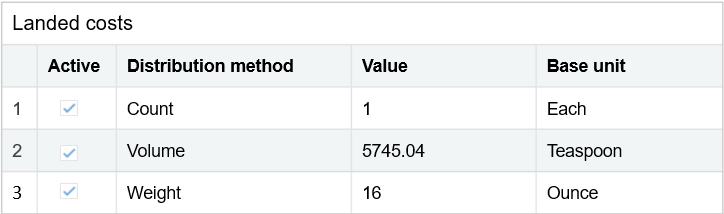
The following is entered in the Value field:
- Count is 1 because the UOM is count
- Volume is 5745.04 (1 cubic foot = 5745.04 teaspoons)
- Weight is 16 (1 pound = 16 ounces)
- Large widget characteristics: Has a UOM group of Count with a base unit of Each, takes up 2 cubic feet of space, weighs 3 pounds See the landed cost setup in the Advanced tab for the item
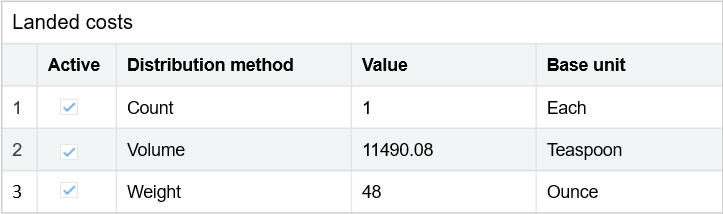
The following is entered in the Value field:
- Count is 1 because the UOM is count
- Volume is 11490.08 teaspoons (2 cubic foot = 5745.04 teaspoons)
- Weight is 48 (3 pounds = 48 ounces)
- Small widget characteristics: Has a UOM group of Count with a base unit of Each, takes up 1 cubic foot of space, weighs 1 pound
- You purchased small and large widgets and then receive a PO purchase invoice for a $100 landed cost, perhaps for freight.
- You create a transaction to enter the actual landed cost of $100 and select to distribute the cost to the purchase of the widgets.
The following table describes the landed cost distribution methods. And, using the above example, shows how the $100 landed cost would be distributed to the purchase of the widgets, based the landed cost distribution method selected in the header of the transaction.
| Landed cost distribution method | Description |
|---|---|
| Value |
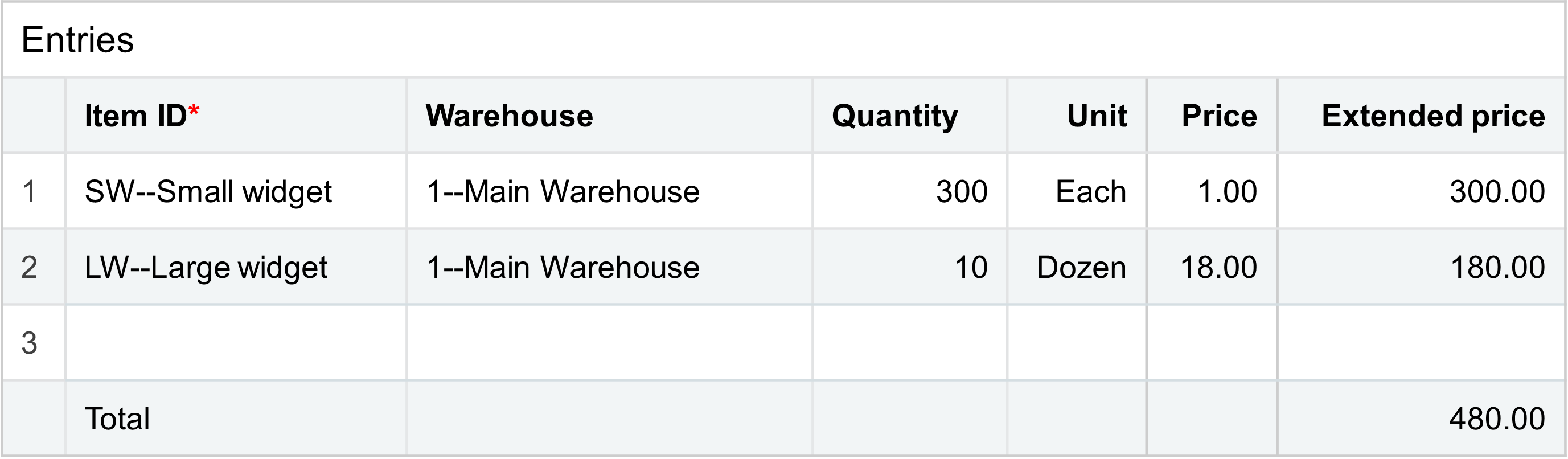
The landed cost is distributed proportionately to each applicable inventory item in the original source transaction based on the Extended price of the items. (You might choose Value for landed costs such as duties, which are typically charged on the total value of shipped items.) The distribution calculation for the $100 landed cost for the original purchase is a weighted average of the Extended price of the inventory items:
|
| Count |
The landed cost is distributed proportionately to each applicable inventory item in the original source transaction based on the number of base units that were purchased. The distribution calculation first ensures that each line item for an inventory item in the original purchase is expressed in its base unit. Small widgets have a UOM of Count and a base unit of Each. No conversion is required. Large widgets have a UOM of Count and a base unit of Each. So, the distribution calculation requires that the quantity for large widgets in Line 2 be converted to the base unit of Each. This makes the quantity for large widgets 120 (10 x 12 in a dozen) and the total quantity for the purchase 420 (300 + 120). Because the UOM group of both line items match the Landed cost distribution method of Count, no other conversion is needed. So, the distribution calculation for the $100 landed cost for the purchase is:
|
| Volume |
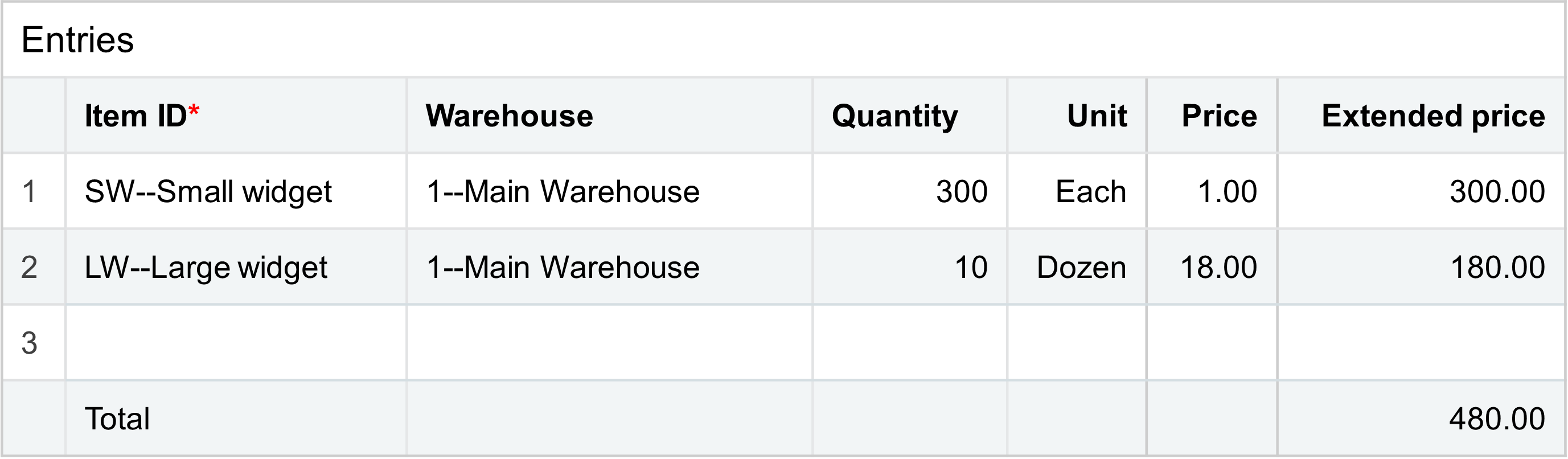
The landed cost is distributed to each applicable inventory item in the original source transaction in proportion to the volume of each item. (You might choose Volume if items differ in size and some take up much more space in a shipping container. Larger items are more likely to cost more to deliver.) Similar to Count in the above row, the distribution calculation first ensures that each line item for an inventory item in the original purchase is expressed in its base unit. So, the quantity of large widgets in Line 2 is converted to 120 (10 x 12 in a dozen). Next, because the UOM group of each line item is not Volume, the value of Volume from the landed cost table in each inventory item is used to convert each transaction line into the base unit for distribution by Volume.
So, the distribution calculation for the $100 landed cost for the purchase is:
|
|
Weight |
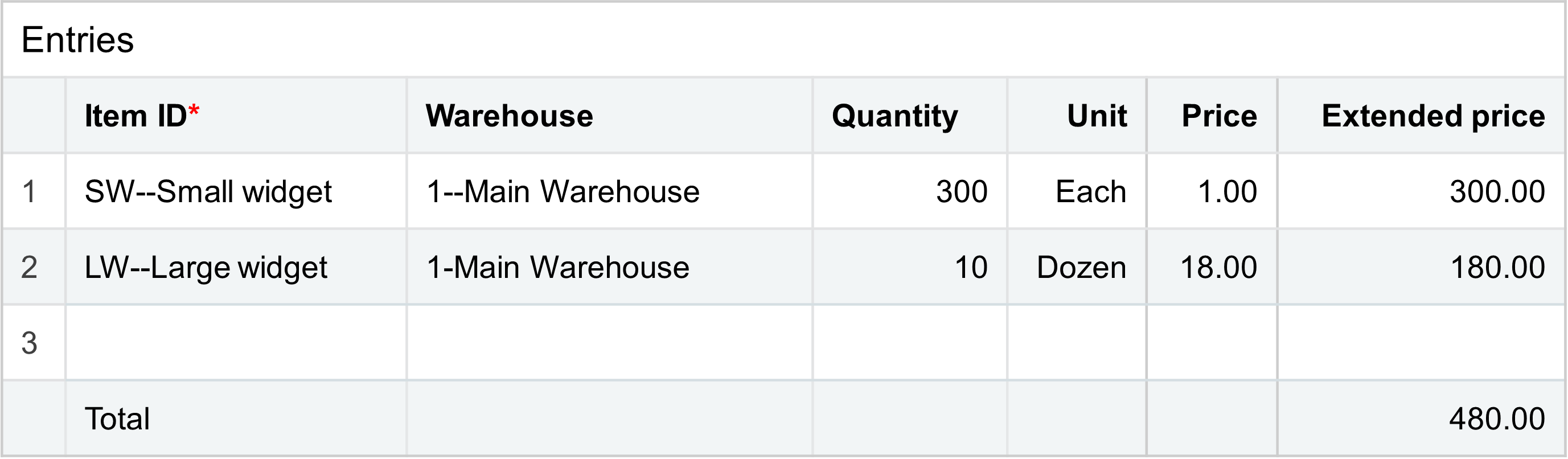
The landed cost is distributed to each applicable inventory item in the original source transaction in proportion to the weight of each item. (You might choose Weight for landed costs that are based on weight, such as freight. Heavier items, like sacks of gravel versus sacks of moss, are more likely to cost more to deliver.) Similar to Count and Volume in the above rows, the distribution calculation first ensures that each line item for an inventory item in the original purchase is expressed in its base unit. So, the quantity of large widgets in Line 2 is converted to 120 (10 x 12 in a dozen). Next, because the UOM group of each line item is not Weight, the value of Weight from the landed cost table in each inventory item is used to convert each transaction line into the base unit for distribution by Weight:
So, the distribution calculation for the $100 landed cost for the purchase is:
See an example where items with different UOM groups are purchased
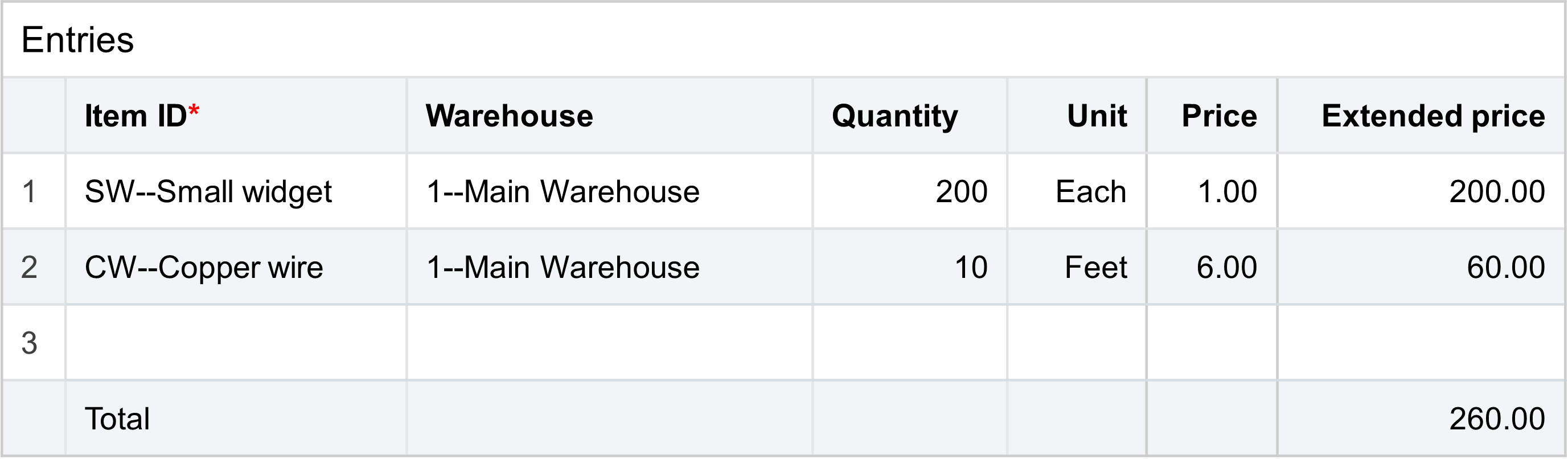
The same purchase transaction is used in the previous examples of how landed costs are distributed, based on the landed cost distribution method that is selected. For Weight, let's look at a more complex example where inventory items with different UOM groups have been purchased:
As in the other examples, a landed transaction was entered with one line item for a $100 landed cost. The distribution calculation first ensures that each line item for an inventory item in the original purchase is expressed in its base unit. Small widgets have a UOM of Count and a base unit of Each. No conversion is required. Copper wire has a UOM of Length and a base unit of Inch. So, the distribution calculation requires that the quantity for copper wire be converted to the base unit of Inch. This makes the quantity for copper wire 120 (12 inches in a foot x 10 feet = 120). Next, because the UOM group of each line item is not Weight, the value of Weight from the landed cost table in each inventory item is used to convert each transaction line into the base unit for distribution by Weight:
So, the distribution calculation for the $100 landed cost for the purchase is:
|