CSV import: Accounts Receivable AR sales invoices
Related information
 Related topics
You can import Accounts Receivable AR sales invoices by uploading a CSV file.
| Subscription |
Accounts Receivable |
|---|---|
| User type |
Business user with admin privileges (All), Employee (List, View), Approver (List, View) |
| Permissions |
AR sales invoices: List, View, Edit, Add, Post If you do not have Post permissions, you can import the transactions as drafts. |
Download a template
| Subscription |
Company |
|---|---|
| Regional availability |
All regions |
| User type |
Business |
| Permissions |
Company Setup Checklist: Run |
Download a new blank template from the Company Setup Checklist whenever you import information into Sage Intacct. Using a downloaded template is important because:
- Templates in the Company Setup Checklist are automatically customized based on your company configuration, including any dimensions and custom fields you created.
- Intacct can update templates at any time, especially when a new version of Intacct is released. If Intacct updates a template, an older template might not work during import.
To download a template from the Company Setup Checklist:
-
Go to Company > Setup > Configuration > Import data.
The Company Setup Checklist opens. You’ll find a list of areas that you can import information into Intacct.
- Decide on a type of information to upload, and select the Template link associated with that information.
Prepare a CSV file for import
When you download a template, the correct headers are in the template already. All you have to do is fill in the columns with your data, save it as a CSV file, and upload the file.
The header titles in the template you download correlate to fields in Intacct. Incorrect header titles will cause an upload error.
For more information about the CSV upload process, including best practices, common errors, and how to upload your CSV file, see Prepare your file for CSV import.
Best practices
The following best practices will help you prepare your CSV file for upload.
Download a template from the Company setup checklist or an object list page.
- Use the latest template, especially following a product release.
- Use the correct template for the area in which you want to upload information. Different templates organize different types of information. Use a template specifically for the information that you need to upload.
- Don’t change the titles in the header row. The header titles correlate to fields in Intacct. Incorrect header titles will cause an upload error. When you download a template from the Company setup checklist, the correct headers are in the template.
- Read the header descriptions in the template. The header description is the cell under the header row that explains what type of information is accepted for each column. If you enter information in the wrong format, or with an incorrect accepted value, it will cause an error in your upload. The header descriptions in the template show you how the information should look. For example, the header in the GL Journal Entries template for JOURNAL shows that allows up to four characters, is required, and has no default values. The header in the Reporting Periods template shows that the STATUS only allows the values 1 or 2, which correlates to True and False, and is not a required field.
- Enter required information. Some data is required, while other data is not. Read the description field to determine which information is required. Required information is necessary for your upload to succeed.
Save the file as a comma-separated value, or CSV, file. If saving from Excel, you could choose the comma-delimited file type.
The file will have the file extension .csv after you save it. Leave the file open until your import is successful. Excel can sometimes reformat the file if you close it before the import is successful.
Avoid common import errors
Intacct recommends following these guidelines to avoid import errors.
In Microsoft Excel:
- Select all cells.
- Right-click the cells and select Format Cells.
- On the Number tab, select Text and then select OK.
- Save the file.
The short date format is formatted like this: 3/15/2021
In Microsoft Excel:
- Select a column of dates.
- Right-click the column and select Format Cells.
- On the Number tab, select Date and select the short date format.
- Save the file.
While spaces within memo fields are allowed, make sure that there are no leading or trailing spaces in any field (not just memos). Leading and trailing spaces might cause import errors. For all other fields, remove unnecessary spaces at the start or end of the data.
In Microsoft Excel:
- Select a range of cells.
- On the Home tab, in the Editing group, select Find & Select and select Replace.
- In the Find what box, enter one space. Leave the Replace with box blank.
- Select Replace All. A prompt opens telling you how many spaces have been removed.
- Save the file.
Commas are used to separate fields in CSV files.
To prevent data from shifting into the wrong columns, avoid using commas in numeric and text fields.
If you must include a comma in a text field, always surround the field with double quotes, for example "Smith, John".
Headers in your CSV file must match the template exactly, including spelling, capitalization, and spacing. Even small changes (such as adding a space or changing a letter’s case) will cause the import to fail. Always use the official template provided by Sage Intacct.
ID fields must contain exact references to customers or suppliers.
ID fields must match exactly, including capitalization. For example, ven100 and VEN100 do not match.
Enter the ID exactly as it appears in Intacct or you run the risk of matching transactions to the wrong supplier or customer, or having the upload fail.
If you reference a supplier, customer, term, budget, etc., in a CSV file, whatever you’re referencing must already exist in Intacct.
For example, if you’re uploading transactions for a vendor, that vendor must already exist in Intacct before you start the upload. If the vendor does not exist, the upload will fail.
This does not apply when creating new customers or suppliers using the import process.
For more information about to correctly number line items, see CSV import: Line number examples.
For fields with predefined valid entries (such as True/False), use initial capitalization. For example True, not TRUE or true. IDs require exact case matches, while predefined entries require initial capitalization.
If your import template contains a country field, for example for an address, make sure that this field has an entry.
If your company has enabled ISO country codes, you must specify the country code in the country field for each record. If you’re unsure whether ISO codes are enabled, check with your administrator or test a sample import to confirm the required format.
Format dates
When uploading your CSV file, you can select a Date Format for the dates in your file.
| Date sequence | Date format |
| Day, month, year |
|
| Month, day, year |
|
| Year, month, day |
|
| Day, month, year |
|
| Month, day, year |
|
| Year, month, day |
|
When you select a date format here, Intacct attempts to import your file using the selected date format. If Intacct can’t import your file with the selected date format, it attempts to discover the date format used in your file and import the data using that date format.
Import a CSV file
Now that you've entered your data and looked through it for any of the common issues imports can have, you’re ready to import your file to Intacct.
To import your CSV file:
-
Go to Company > Setup > Configuration > Import data.
- Find the information type that you want to import, and select the corresponding Import link.
-
In the Import Company Information dialog, set the following and select Import:
Import Company Information: optionsImport file option descriptions Option Description Browse
Use the Browse button to locate and select the CSV file you want to import.
Date format
When you select a date format here, Sage Intacct attempts to import your file using the selected date format. If Intacct can’t import your file with the selected date format, it attempts to discover the date format used in your file and import the data using that date format.
File encoding
Leave this option set to "auto-detect" unless you're unable to import your file. Depending on your operating system, you may need to select a different type of file encoding.
Process offline
Some imports can take considerable time, depending on their size and how much processing the system must do on the uploaded data. If you're not sure how much time your upload will take, select Process offline. When the system completes the process, it sends an email to the address you provide in the Email results to this address field. The system also sends you any errors that may have occurred in the process. If you prefer to wait until the upload process is complete, don’t select the Process offline checkbox.
Transactions and other records that are processed offline show a source of System in the audit trail, instead of CSV import.
Email results to this address
Email address to which import results and errors should be sent. You can enter multiple email addresses, separated by a semicolon (;) or comma (,).
Sage Intacct highly recommends entering an email address.
After an import, Sage Intacct informs you if the import was successful and how many records were imported.
In a completely successful import, the confirmation page lets you verify all the records in your original file were, in fact, successfully imported without having to verify them manually.
Offline CSV imports
Some imports can take considerable time, depending on their size and how much processing Intacct must do to the data. When in doubt, select Process offline on the import utility page.
When the offline process is complete, Intacct sends an email to the address you entered in the Import Company Information dialog (where you imported your file).
Intacct recommends that you select Process offline when importing CSV files, and provide your email address. If your import fails, you’ll always be notified, and the failed records are sent to your email.
Handle errors
If you experience import errors, review the importing tips and common errors.
Import errors occur when you try to import information that doesn’t match the requirements of the template. Each template has a set of required information you must enter to import the file successfully, and formats to follow for certain kinds of information. Read the descriptions in the template to determine the most accurate way to enter your data.
If individual transactions are in error, the rows in the transaction that are in error are saved in a CSV file for you along with an error code for each row. Check your email for information about specific errors. See Find and fix CSV import errors for more information.
For more information about the CSV upload process, read Prepare your file for CSV import.
About AR AR sales invoice CSV file fields
When you import AP purchase invoices, AR sales invoices, or adjustments, you choose the type of transaction they will be imported as: live or historical transactions
- Live transactions are imported and posted to the GL.
OR
- Historical transactions are imported and are not posted to GL. Instead, they are posted to either the AP or AR subledgers.
If you apply a payment to a historical transaction (AP purchase invoice or AR sales invoice), Intacct updates the subledger and the GL. This reduces your AP and AR, and affects cash.
Journals must be established
Before you upload any transactions, you must establish journals for the transactions. Do this through Company > Admin > Subscriptions, and then configuring journals for both AP and AR applications before you import open AP purchase invoices, AR sales invoices, and adjustments.
Use row numbers
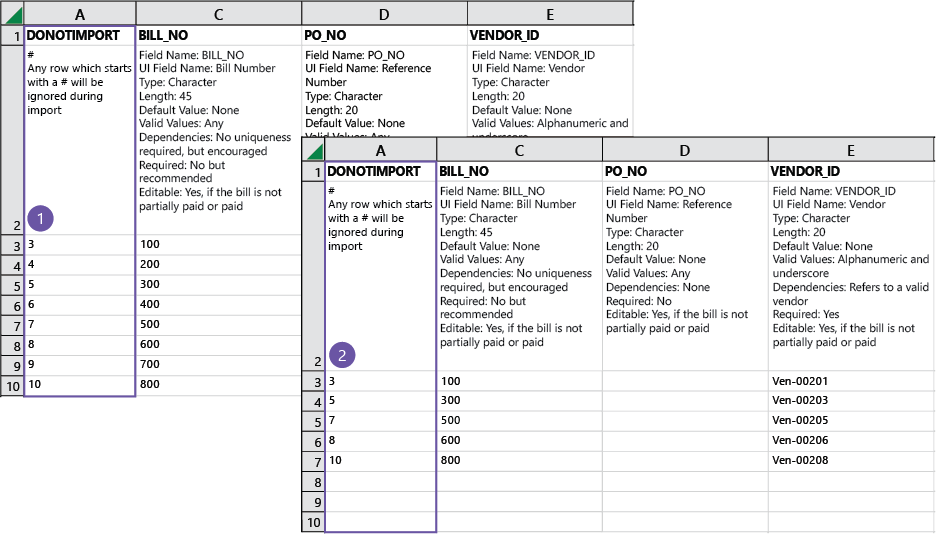
When importing AP purchase invoices or AR sales invoices, if errors are found during upload, the entire CSV file is rejected. You can more easily find the errors in the file if you use row numbers in the Do Not Import column (1). If your CSV file is rejected because errors are found, the error file contains the original row number, allowing you to quickly pinpoint where to make changes (2).
Field descriptions
The field definitions in your template explain what type of information is required for each field, and how to enter valid information. It's always a good idea to read the field definitions before making entries.
You can reorder the columns of your CSV file for ease of use. However, the column header must contain the field name exactly as it appears in the original template.
If you downloaded a template from the Company Setup Checklist or an object list page, your template contains the headers and dimensions that are specific to your company. The headers in a standard template might not contain field definitions specific to your company.
To import dimension values, enter information in the appropriate dimension column of the import spreadsheet. Otherwise, no information appears for that dimension.
If you relabeled any dimensions (see Terminology for more information), your dimension name does not appear in the CSV template, but the original Intacct dimension name does.
The total of the deferred revenue scheduled entries does not need to match the line item total. The total of the deferred revenue entries can be less than the line item total.
The Supporting Document ID field in the AR sales invoices page is not present in the template. Do not enter information in this field if your template contains this header.
| Field Name: | DONOTIMPORT |
|---|---|
|
# |
Any row that starts with # is ignored during import. |
| Field Name: | SUMMARY_TITLE |
|
UI Field Name: |
Summary |
|
Type: |
Character |
|
Length: |
70 (Not including prepended value, see Dependencies) |
|
Default Value: |
None |
|
Valid Values: |
Any |
|
Dependencies: |
Summary will be prepended with "HISTORY" |
|
Required: |
No |
|
Editable: |
Yes |
|
Notes: |
All transactions imported with the same summary title are uploaded with the same GL posting date defined on the first transaction line.
AR sales invoices imported into an existing batch receive the same GL posting date defined for that batch. Select a Summary Type before you import AP purchase invoices, AR sales invoices, or Adjustments. Depending on whether you include a SUMMARY_TITLE, manual or automatic summaries are created.
Also, SUMMARY_TITLE is prepended with "HISTORY". |
| Field Name: | INVOICE_NO |
|
UI Field Name: |
AR sales invoice Number |
|
Type: |
Alphanumeric |
|
Length: |
45 |
|
Default Value: |
None |
|
Valid Values: |
Alphanumeric |
|
Dependencies: |
None |
|
Required: |
No |
|
Editable: |
Yes |
| Field Name: | PO_NO |
|
UI Field Name: |
Reference Number Other names for Reference Numbers
When entering information about AP purchase invoices, you might see several different terms used to mean the same thing. Reference number, PO Number, and DOC number all refer to the number assigned to your AP purchase invoice, but are used in different places in Intacct.
|
|
Type: |
Alphanumeric |
|
Length: |
100 |
|
Default Value: |
None |
|
Valid Values: |
Alphanumeric |
|
Dependencies: |
None |
|
Required: |
No |
|
Editable: |
Yes |
| Field Name: | CUSTOMER_ID |
|
UI Field Name: |
Customer |
|
Type: |
Alphanumeric |
|
Length: |
21 |
|
Default Value: |
None |
|
Valid Values: |
Alphanumeric |
|
Dependencies: |
Must refer to a customer that already exists in Intacct. |
|
Required: |
Yes |
|
Editable: |
No |
| Field Name: | POSTING_DATE |
|
UI Field Name: |
GL posting date |
|
Type: |
Date |
|
Length: |
10 |
|
Default Value: |
None |
|
Valid Values: |
Any valid date format |
|
Dependencies: |
None |
|
Required: |
No |
|
Editable: |
Yes, if the AP purchase invoice is not partially paid or paid. |
| Field Name: | CREATED_DATE |
|
UI Field Name: |
Date |
|
Type: |
Date |
|
Length: |
10 |
|
Default Value: |
None |
|
Valid Values: |
Date |
|
Dependencies: |
None |
|
Required: |
Yes |
|
Editable: |
No |
| Field Name: | DUE_DATE |
|
UI Field Name: |
Due Date |
|
Type: |
Date |
|
Length: |
10 |
|
Default Value: |
None |
|
Valid Values: |
Date |
|
Dependencies: |
Cannot be before the CREATED_DATE. |
|
Required: |
Yes |
|
Editable: |
No |
| Field Name: | TOTAL_DUE |
|
UI Field Name: |
Amount |
|
Type: |
Number |
|
Length: |
38,2 |
|
Default Value: |
None |
|
Valid Values: |
Number |
|
Dependencies: |
None |
|
Required: |
Yes |
|
Editable: |
No |
| Field Name: | TOTAL_PAID |
|
UI Field Name: |
No corresponding field in the Create AP purchase invoice page. This is the amount of a prior partially paid AP purchase invoice. |
|
Type: |
Number |
|
Length: |
38,2 |
|
Default Value: |
None |
|
Valid Values: |
Should non-zero with negatives designated by a leading dash |
|
Dependencies: |
None |
|
Required: |
No |
|
Editable: |
No |
| Field Name: | PAID_DATE |
|
UI Field Name: |
No corresponding field in the Create AP purchase invoice page. This would be the date of a prior partially paid AP purchase invoice. |
|
Type: |
Date |
|
Length: |
10 |
|
Default Value: |
None |
|
Valid Values: |
Date |
|
Dependencies: |
Cannot be before the CREATED_DATE. |
|
Required: |
No |
|
Editable: |
No |
| Field Name: | BILL_BACK_TEMPLATE |
|
UI Field Name: |
Bill back template |
|
Type: |
Alphanumeric |
|
Length: |
40 |
|
Default Value: |
None |
|
Valid Values: |
Alphanumeric |
|
Dependencies: |
Must be the template ID of a valid bill back template that already exists in Intacct. |
|
Required: |
No |
| Field Name: | TERM_NAME |
|
UI Field Name: |
Term |
|
Type: |
Alphanumeric |
|
Length: |
40 |
|
Default Value: |
None |
|
Valid Values: |
Alphanumeric |
|
Dependencies: |
Must refer to an AR term that already exists in Intacct. |
|
Required: |
No |
|
Editable: |
No |
| Field Name: | DESCRIPTION |
|
UI Field Name: |
Description |
|
Type: |
Alphanumeric |
|
Length: |
1000 |
|
Default Value: |
None |
|
Valid Values: |
Alphanumeric |
|
Dependencies: |
None |
|
Required: |
No |
|
Editable: |
No |
| Field Name: | BASECURR |
|
UI Field Name: |
Base Currency |
|
Type: |
Character |
|
Length: |
3 |
|
Default Value: |
None |
|
Valid Values: |
Any defined ISO three-letter ISO-4127 currency code such as USD or EUR |
|
Dependencies: |
Must reference a previously defined currency; locations in line items must use the same base currency. |
|
Required: |
No, except for shared multi-entity companies with multiple base currencies. |
|
Editable: |
No |
|
Notes: |
Applies only to shared multi-entity companies with multiple base currencies. This field defines the transaction base currency. Verify that locations in line items use the same base currency. |
| Field Name: | CURRENCY |
|
UI Field Name: |
Currency |
|
Type: |
Character |
|
Length: |
3 |
|
Default Value: |
Base Currency |
|
Valid Values: |
Any defined currency, such as USD or EUR; blank denotes base currency |
|
Dependencies: |
Must reference a previously-defined currency |
|
Required: |
No |
|
Editable: |
Yes |
|
Notes: |
Use only for multi-currency companies. This field defines the transaction currency. If no field is defined here, the base currency is used. Applies only if your company uses foreign currency transactions, and the transaction is in a foreign currency. Otherwise, this field is optional, and the system uses the base currency. |
| Field Name: | EXCH_RATE_DATE |
|
UI Field Name: |
Exchange Rate Date |
|
Type: |
Date |
|
Length: |
10 |
|
Default Value: |
Today |
|
Valid Values: |
Any valid date format |
|
Dependencies: |
None |
|
Required: |
Yes, unless you provide the EXCHANGE_RATE |
|
Editable: |
Yes |
|
Notes: |
Use only for multi-currency companies. This field determines the exchange rate as of this date. Applies only if your company uses foreign currency transactions, and the transaction is in a foreign currency. Otherwise, this field is optional, and the system uses the base currency. |
| Field Name: | EXCH_RATE_TYPE_ID |
|
UI Field Name: |
Exchange Rate Type |
|
Type: |
Character |
|
Length: |
40 |
|
Default Value: |
Intacct Daily Rate, unless a custom exchange rate is defined as the default |
|
Valid Values: |
Alphanumeric and underscore |
|
Dependencies: |
Must reference a previously defined exchange rate type |
|
Required: |
No |
|
Editable: |
Yes |
|
Notes: |
Use only for multi-currency companies. Defines an optional custom exchange rate type. The Intacct Daily Rate is used if no optional one is defined here. Applies only if your company uses foreign currency transactions, and the transaction is in a foreign currency. Otherwise, this field is optional, and the system uses the base currency. |
| Field Name: | EXCHANGE_RATE |
|
UI Field Name: |
Exchange Rate |
|
Type: |
Number |
|
Length: |
17, not including decimal point |
|
Default Value: |
Defaults to the exchange rate of the CURRENCY on the EXCH_RATE_DATE for the EXCH_RATE_TYPE. |
|
Valid Values: |
Positive integers |
|
Dependencies: |
None |
|
Required: |
No |
|
Editable: |
Yes |
|
Notes: |
Use only for multi-currency companies. Overrides the default exchange rate, which is the product of the CURRENCY, EXCH_RATE_DATE, and EXCH_RATE_TYPE. Applies only if your company uses foreign currency transactions, and the transaction is in a foreign currency. Otherwise, this field is optional, and the system uses the base currency. |
| Field Name: | LINE_NO |
|
UI Field Name: |
No field name as such. These are the incrementing numbers on the left side of the transaction area in the AP purchase invoices page. |
|
Type: |
Number |
|
Length: |
4 |
|
Default Value: |
None |
|
Valid Values: |
Number |
|
Dependencies: |
None |
|
Required: |
Yes |
|
Editable: |
No |
|
Note: |
Starts with 1 for the first line of a transaction, and increments by one for each subsequent line within a transaction. Example of line numbers. |
| Field Name: | MEMO |
|
UI Field Name: |
Memo |
|
Type: |
Character |
|
Length: |
1000 |
|
Default Value: |
None |
|
Valid Values: |
Any |
|
Dependencies: |
None |
|
Required: |
No |
|
Editable: |
No |
| Field Name: | ACCT_NO |
|
UI Field Name: |
Account |
|
Type: |
Alphanumeric |
|
Length: |
24 |
|
Default Value: |
None |
|
Valid Values: |
Alphanumeric |
|
Dependencies: |
Must refer to an account number that already exists in Intacct. Also must conform to primary and subaccount specification established in the Company Information page. To access the Company Information page, go to Company > All > Setup > Configuration. |
|
Required: |
Yes |
|
Editable: |
No |
| Field Name: | ACCT_LABEL |
|
UI Field Name: |
Account Label |
|
Type: |
Alphanumeric |
|
Length: |
80 |
|
Default Value: |
None |
|
Valid Values: |
Alphanumeric |
|
Dependencies: |
Should already exist |
|
Required: |
No |
|
Editable: |
No |
| Field Name: | LOCATION_ID |
|
UI Field Name: |
Location |
|
Type: |
Character |
|
Length: |
20 |
|
Default Value: |
None |
|
Valid Values: |
Must refer to a location that already exists in Intacct. |
|
Dependencies: |
None, except that in shared multi-entity companies with multiple base currencies, the LOCATION_ID must use the same currency as the BASECURR field. |
|
Required: |
No |
|
Editable: |
Yes, if the AP purchase invoice is not partially paid or paid |
|
Notes: |
In shared multi-entity companies with multiple base currencies, LOCATION_ID must be in an entity that uses the same base currency as BASECURR. |
| Field Name: | DEPT_ID |
|
UI Field Name: |
Department |
|
Type: |
Alphanumeric |
|
Length: |
20 |
|
Default Value: |
None |
|
Valid Values: |
Alphanumeric |
|
Dependencies: |
Must refer to a department that already exists in Intacct. |
|
Required: |
No |
|
Editable: |
No |
| Field Name: | ALLOCATION_ID |
|
UI Field Name: |
Allocation |
|
Type: |
Character |
|
Length: |
50 |
|
Default Value: |
None |
|
Valid Values: |
An existing valid transaction allocation |
|
Dependencies: |
None |
|
Required: |
No |
|
Editable: |
No |
| Field Name: | AMOUNT |
|
UI Field Name: |
Amount |
|
Type: |
Number |
|
Length: |
38,2 |
|
Default Value: |
None |
|
Valid Values: |
Should be non-zero with negatives designated by a leading dash |
|
Dependencies: |
None |
|
Required: |
Yes |
|
Editable: |
No |
|
Notes: |
Amount refers to line items that make up a total payment. For example, if an AR sales invoice was $1000, and each line item in the AR sales invoice was $200, there would be one line with $1000 in the Total Due column, and then five separate lines with $200 in the Amount column. The total of the Amount column must match the total for the Total Due column if they are identified for the same AR sales invoice. |
| Field Name: | SUBTOTAL |
|
UI Field Name: |
Subtotal |
|
Type: |
T=Tags a line as a subtotal |
|
Default Value: |
By default the line items are not part of the subtotal |
|
Notes: |
Can only be used when Account Labels are enabled |
| Field Name: | REVREC_TEMPLATE |
|
UI Field Name: |
Rev Rec Template |
|
Type: |
Alphanumeric |
|
Length: |
40 |
|
Default Value: |
None |
|
Valid Values: |
Alphanumeric |
|
Dependencies: |
Refers to an existing template. |
|
Required: |
Yes, if the line is to be deferred. |
|
Editable: |
No |
| Field Name: | REVREC_STARTDATE |
|
UI Field Name: |
Rev Rec Start Date |
|
Type: |
Date |
|
Length: |
10 |
|
Default Value: |
None |
|
Valid Values: |
Any valid date format. |
|
Dependencies: |
None |
|
Required: |
No |
|
Editable: |
No |
| Field Name: | DEFERREDREV_ACCOUNT |
|
UI Field Name: |
Default Deferred Revenue Account |
|
Type: |
Number |
|
Length: |
24 |
|
Default Value: |
None |
|
Valid Values: |
Numeric |
|
Dependencies: |
Refers to an existing account number. |
|
Required: |
Yes, if the line is to be deferred. |
|
Editable: |
No |
| Field Name: | REVREC_JOURNAL |
|
UI Field Name: |
Revenue Recognition Journal |
|
Type: |
Character |
|
Length: |
4 |
|
Default Value: |
None |
|
Valid Values: |
Alphanumeric |
|
Dependencies: |
Refers to an existing journal. |
|
Required: |
Yes, if the line is to be deferred. |
|
Editable: |
No |
| Field Name: | REVREC_SCHEDULE_LINE_NO |
|
UI Field Name: |
No field name as such. These are the incrementing numbers on the left side of the transaction line items area. |
|
Type: |
Number |
|
Length: |
4 |
|
Default Value: |
None |
|
Valid Values: |
Numeric |
|
Dependencies: |
Start with 1 for the first schedule entry, and increment by one for each subsequent entry. |
|
Required: |
Yes, if the line is deferred. |
|
Editable: |
No |
| Field Name: | REVENUE_ACCOUNT |
|
UI Field Name: |
Revenue account you see when you drill down on the rev rec schedule link from the AR AR sales invoice, and to which the sales amount is posted to GL when revenue is recognized. |
|
Type: |
Number |
|
Length: |
24 |
|
Default Value: |
None |
|
Valid Values: |
Numeric |
|
Dependencies: |
Refers to an existing account number. |
|
Required: |
Yes, if the line is to be deferred. |
|
Editable: |
No |
| Field Name: | REVREC_POSTINGDATE |
|
UI Field Name: |
N/A |
|
Type: |
Date |
|
Length: |
10 |
|
Default Value: |
None |
|
Valid Values: |
Any valid date format. |
|
Dependencies: |
None |
|
Required: |
Yes, if the line is deferred. |
|
Editable: |
No |
| Field Name: | REVREC_AMOUNT |
|
UI Field Name: |
Amount |
|
Type: |
Number |
|
Length: |
38,2 |
|
Default Value: |
None |
|
Valid Values: |
Numeric |
|
Dependencies: |
None |
|
Required: |
Yes, if the line is deferred. |
|
Editable: |
No |
| Field Name: | TAXSOLUTIONID - This field only applies to companies subscribed to the Taxes application. |
|
UI Field Name: |
Transaction solution |
|
Type: |
Character |
|
Length: |
100 |
|
Default Value: |
0 |
|
Valid Values: |
Alphanumeric |
|
Dependencies: |
None |
| Required: | Yes, if your organization is configured for multiple tax jurisdictions and you are importing at the top level |
|
Editable: |
No |
| Field Name: | TAX_LINE_NO - This field only applies to companies subscribed to the Taxes application. |
|
UI Field Name: |
No field name as such. These are the incrementing numbers for the tax lines specific to line items. |
|
Type: |
Number |
|
Length: |
4 |
|
Default Value: |
None |
|
Valid Values: |
Positive integer |
|
Dependencies: |
The Taxes subscription is enabled for a VAT or GST solution. Start with 1 for the first tax line of a line item, and increment by one for each subsequent line. |
|
Required: |
Yes, for VAT or GST tax solutions |
|
Editable: |
No |
| Field Name: | TAX_AMOUNT - This field only applies to companies subscribed to the Taxes application. |
|
UI Field Name: |
Transaction tax |
|
Type: |
Number |
|
Length: |
38,2 |
|
Default Value: |
None |
|
Valid Values: |
Any, with negatives values designated by a leading dash |
|
Dependencies: |
The Taxes subscription is enabled for a VAT or GST tax solution. |
|
Required: |
No |
|
Editable: |
Yes, if the invoice is not partially paid or paid |
| Notes: | This field is only applicable for VAT or GST tax solutions. The amount entered will override the tax calculated by the tax detail. |
| Field Name: | TAX_DETAILID - This field only applies to companies subscribed to the Taxes application. |
|
UI Field Name: |
Tax detail |
|
Type: |
Character |
|
Length: |
30 |
|
Default Value: |
None |
|
Valid Values: |
Refers to a valid tax detail ID |
|
Dependencies: |
The Taxes subscription is enabled for a VAT or GST tax solution. |
|
Required: |
Yes, for VAT or GST tax solutions |
|
Editable: |
Yes, if the invoice is not partially paid or paid |
